Infrared (IR) Cut Filter
What is an IR Cut Filter? Overview and Importance
An IR Cut Filter is a critical optical component designed to block unwanted infrared (IR) light sensed by digital cameras and optical sensors while allowing only visible light to pass through. Image sensors such as CMOS and CCD are highly sensitive to infrared light, which is invisible to the human eye. Without a filter, this leads to color distortion—such as “reddish blacks”—and image blurring. IR cut filters suppress these issues, enabling natural, vivid color reproduction and high-definition rendering.
Key Functions and Applications
Optimization of Color Reproduction: Maintains natural tones close to what the human eye sees, even under strong sunlight or intense light sources. Day/Night Switching for Surveillance: Directly improves image quality by providing natural color images during the day and high-sensitivity monochrome images at night (by removing the filter).
Enhanced Sensing Precision: Eliminates ambient light noise in automotive LiDAR and FA (Factory Automation) cameras.
When selecting a product, the key to maximizing optical performance lies in matching the material (absorption vs. reflection type), cutoff wavelength characteristics (transmittance), and size to the specific camera specifications.
IRC-1200
The IRC-1200 is a high-performance filter designed to transmit a broad spectrum from 400nm (visible) to 1100nm (NIR), while effectively cutting unwanted wavelengths between 1200nm and 1700nm. It is an ideal solution for multispectral cameras and wide-range imaging systems, ensuring superior sensing accuracy by eliminating noise in the extended infrared region.
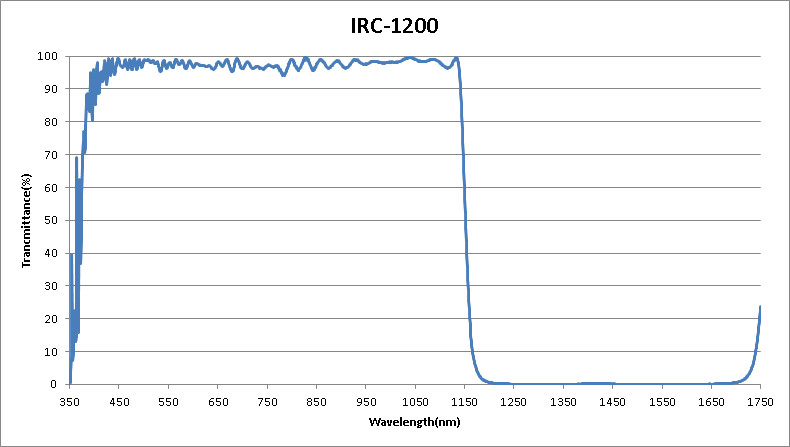
wide-range cut IR CUT FILTER
A high-precision filter that blocks a wide range of the near-infrared spectrum. It supports ultra-thin manufacturing (substrate thickness under 1mm), contributing to device miniaturization. It is particularly ideal as a wavelength selection filter for products equipped with IMX990/IMX991 sensors, which have sensitivity ranging from visible light to Short-Wave Infrared (SWIR). By extracting or cutting specific wavelengths, it pushes sensing accuracy to the limit.

Low angle-dependent IR CUT FILTER
This filter minimizes “blue shift”—the change in transmission characteristics based on the angle of incidence. It maintains uniform color reproduction across the entire frame, even in optical systems where light enters from diverse angles, such as wide-angle lenses, drones, and autonomous driving sensors. Stable characteristics simplify system design, improving reliability and reducing costs for surveillance cameras and night vision systems.

IRC660
A filter specialized in faithful reproduction of the visible spectrum by cutting infrared light from approximately 650nm. By cutting at a shorter wavelength than the IRC660, it suppresses red-component saturation. It is ideal for high-definition cameras and inspection equipment requiring strict color balance, achieving a natural tone close to the human eye.

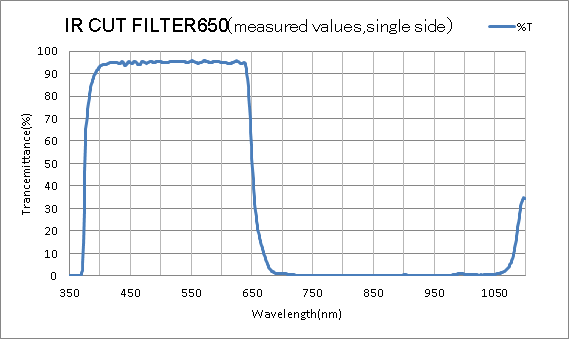
IRC650
“IRC650” (Standard type) that rejects wavelength range of 700nm to 1050nm. A highly versatile standard model that efficiently transmits visible light while effectively removing unwanted infrared. Mounted on the CMOS/CCD light-receiving surface of digital cameras and general sensors, it suppresses IR-induced noise and color casting, enhancing perceived resolution. It offers an excellent balance of cost and performance.
.
IRC730
A specially designed filter that utilizes light up to approximately 730nm while suppressing the subsequent IR range. Because it allows longer wavelengths to pass than a standard IR cut filter, it balances brightness with clear imagery in nighttime photography, low-light environments, or when used alongside IR cameras. It is effective for biometrics and surveillance systems utilizing specific near-infrared wavelengths.

IRC-65S
“IRC-65S”(standard type IR cut filters) that cut near-infrared light near 700 -800 nm. A standard, cost-effective model that sharply cuts near-infrared light beyond the visible spectrum. By thoroughly eliminating unwanted IR components, it prevents color muddiness and enables precise color reproduction. It proves its value in measurement environments such as scientific research and industrial color inspection where accurate color data is paramount.

IRC-78S
“IRC-78S” that block near-infrared light near 800-950 nm. A filter boasting high cutoff efficiency for specific near-infrared wavelengths. By controlling the boundary around 780nm, it blocks IR noise to the sensor while utilizing visible light sensitivity. It is best suited for industrial imaging applications where maintaining contrast and clarity under specific optical conditions is required.

IRC-65L
“IRC-65L” uses heat absorbing glass to cut near-infrared light in broadband. Since the material itself absorbs infrared, it suppresses sensor malfunction caused by heat even under strong outdoor sunlight. With extremely high durability and data reliability, it is ideal for harsh environments such as automotive cameras and high-precision industrial sensors

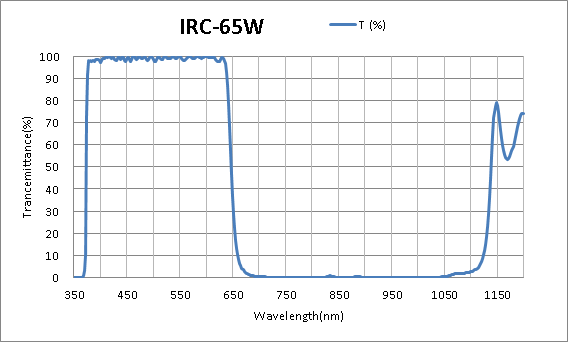
IRC-65W
“IRC-65W” uses only the coating properties to cut near-infrared light over broadband without use of heat absorbing glass. A high-end glass filter that evolves the vapor deposition technology of the IRC-65S into a double-layered structure. Through proprietary multi-layer coating technology, we have succeeded in making the IR stopband “wider and deeper.” It thoroughly eliminates noise, achieving overwhelming color reproduction and a Signal-to-Noise Ratio (SNR) that surpasses conventional products.
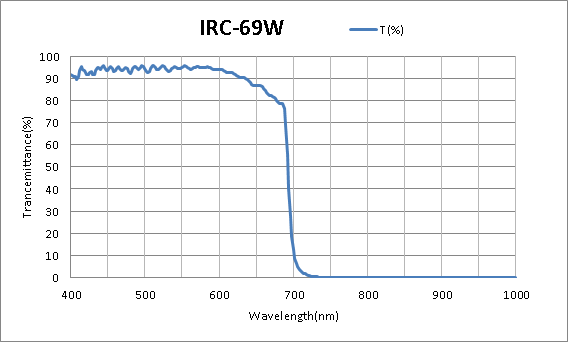
IRC-69W
“IRC-69W” is a combination of a coating and heat absorbing glass that cut near-infrared light in broadband as the same as IRC-65W. It fuses the high-precision double-coating technology developed for the IRC-65W with heat-absorbing glass. By utilizing both absorption and reflection mechanisms, it blocks unwanted IR to the extreme. We can accommodate various glass materials; this product prevents sensor saturation even in harsh thermal environments, achieving the pinnacle of color reproduction.